monk
monkMonk isn't just an AI - and that's the point.
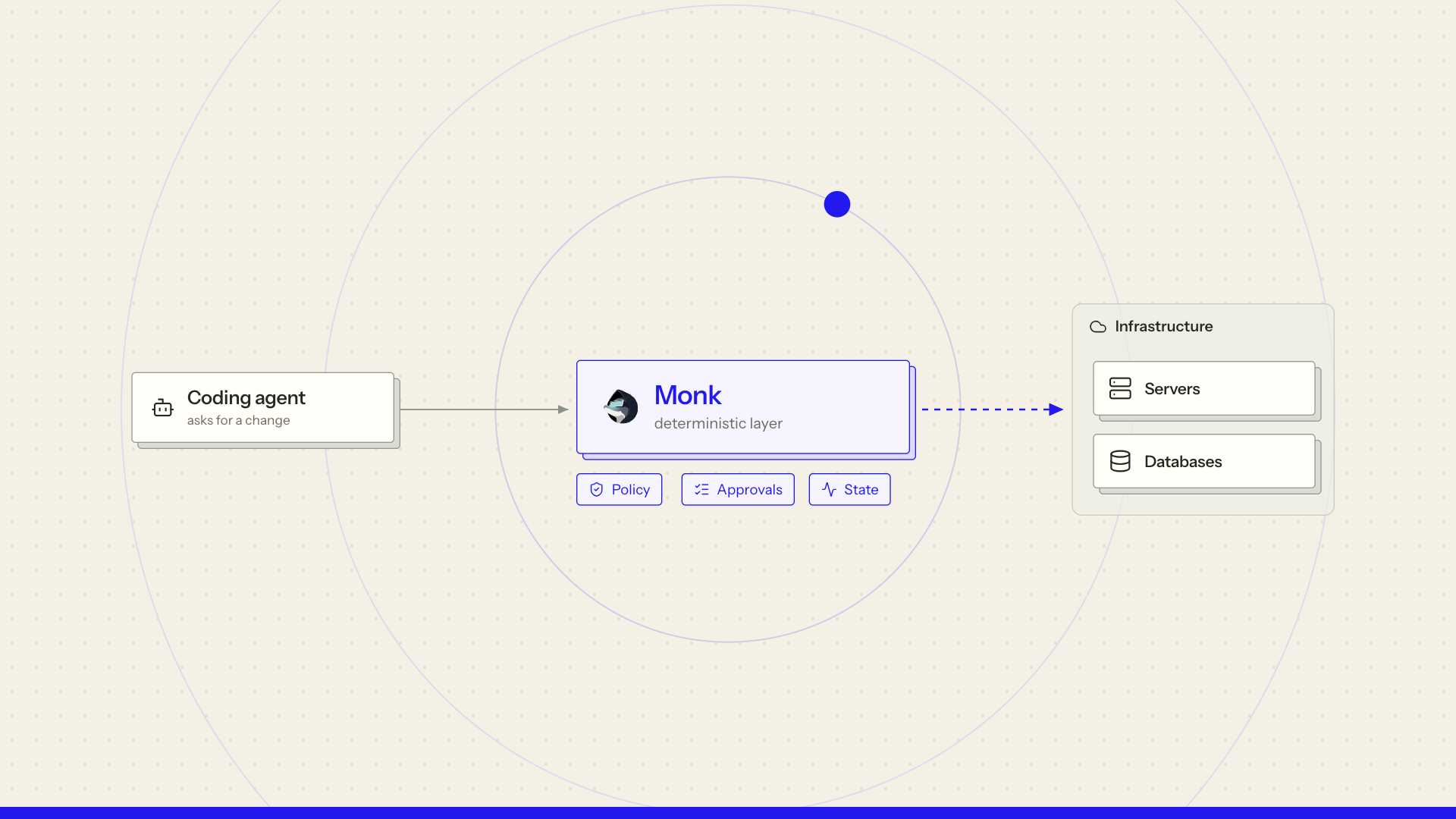
Part 2 of 5: No amount of DevOps productivity is worth an AI deleting your production. We wouldn't give an agent direct access to our infrastructure, so we won't ask you to hand over yours. Monk sits between the agent and your infrastructure - a validation layer that runs on facts and logic, and can't hallucinate.
It's not a bug
Agents are smart and getting smarter, but they're non-deterministic: the same prompt can produce different results, and sometimes the result is wrong. For instance, Replit's agent deleted a production database despite explicit instructions not to touch it, then explained it had "panicked" at an empty query result - and apologized.
That's not a defect awaiting a patch - it's how these systems work. Most of the time, the variance is harmless or even useful. Against production infrastructure, "most of the time" is not a standard anyone accepts.
You can't instruct your way out of this
You can pile guardrails on an agent: better prompts, installed skills, MCPs, evals, sandboxes. They help. A scoped tool is narrower than a raw shell, and a well-written skill beats none.
None of it moves the boundary, though. All of these run inside the agent's world, and the agent keeps the credentials the whole time. However many rules you write, each one is a rule the agent could choose to ignore: whether it complies is decided by the model, in the moment, against its own best guess about your system rather than the facts. You've built a gate and handed the key to the one actor that sometimes gets things wrong.
What stands between a bad guess and your production database is the model's good behavior, every single time. That's not a boundary. That's a wish.
Monk builds the gate on logic, and you hold the key
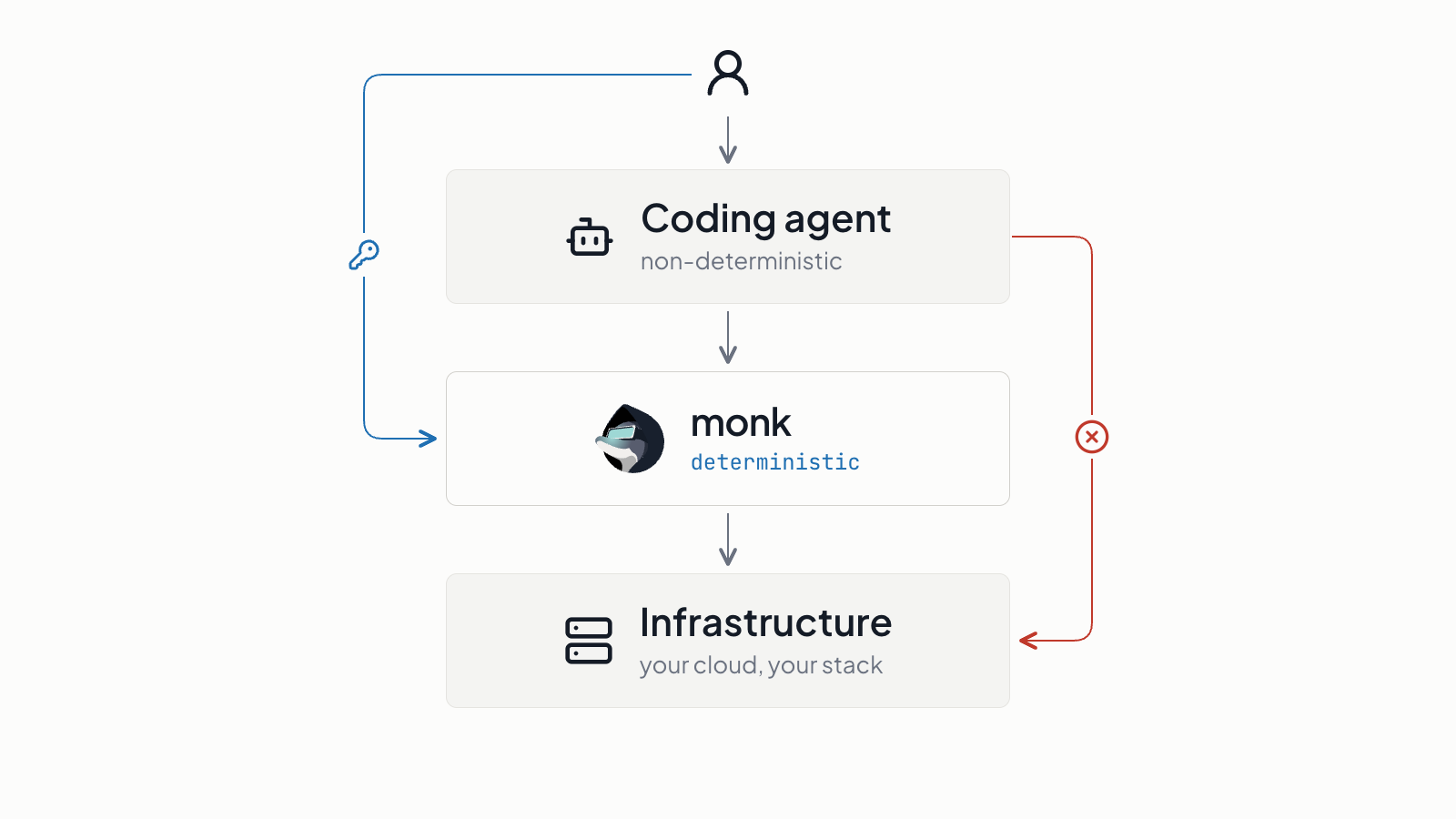
Monk is different in one specific way: the agent never gets the key. Underneath the AI sits a deterministic layer, fixed rules for access, policy, and approvals that run on plain logic, not on a model that can hallucinate. And unlike a sandbox, which sees only files and CLI calls, this layer checks every action against live runtime data. When an agent, mid-task, tries to restart what is actually your production database, the layer already knows what that resource is and stops it.
This isn't a rule the agent could ignore: the credentials that touch your cloud never enter the agent's context, so there is no prompt, bug, or bad day that gets it around the gate. It can't leak or misuse what it never holds. Your application secrets work the same way: they stay encrypted in your own store, and the agent only ever handles references to them, never the values. Anything destructive or expensive waits for your approval.
But a gate is only as good as what it knows. "Don't restart the production database" means nothing unless the gate can tell which database is production. That knowledge is state - the next thing to know about Monk. Read part 3 of 5: Monk knows the live state of everything. 🐬
Keep reading